
What we know about North Sea oil tanker and cargo ship collision
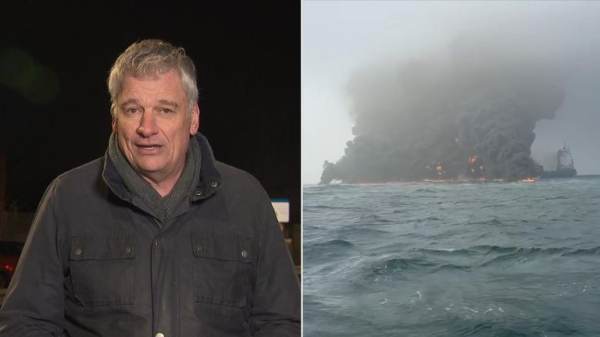
An oil tanker and cargo ship collided in the North Sea off the coast of East Yorkshire on Monday morning, forcing crew members to abandon ship.
Both vessels burst into flames after the crash about 13 miles from the coast.
The fire on the tanker continued to burn overnight into Tuesday.
Here is everything we know.
Follow North Sea latest: Fire rages as search called off
How many casualties are there?
36 people were brought ashore and one was taken to hospital.
One crew member of the Solong container ship remains missing and the search has now been called off.
The Coastguard said efforts to find the person ended at around 9.40pm on Monday after “an extensive search”.

What we know about the collision
The alarm was first raised at 9.48am, before HM Coastguard tasked a number of lifeboats to support its response at 10.20am.
The collision involved a US-flagged oil tanker called the Stena Immaculate and the Solong – a container ship sailing under a Portuguese flag.
The Stena Immaculate was carrying 220,000 barrels of jet fuel in 16 segregated cargo tanks when it was struck.

Authorities said reports came in of a “massive fireball” after the incident, and images of the aftermath show both ships on fire and billowing smoke.
Tracking data shows the moment of the crash, with the Stena Immaculate seemingly stationary as the Solong sails towards it.

In audio released following the incident, the coastguard requesting emergency services says the Solong collided with the tanker.
The oil tanker’s management firm, Crowley, has since revealed it sustained a ruptured cargo tank after it was struck, causing “multiple explosions” and jet fuel to be released into the water.
In a statement on Monday afternoon, Crowley said: “A fire occurred as a result of the allision, and fuel was reported released.
“The Stena Immaculate crew abandoned the vessel following multiple explosions onboard.
“All Crowley mariners are safe and fully accounted for.
“Crowley immediately initiated its emergency vessel response plan and is actively working with public agencies to contain the fire and secure the vessel.”
A US military spokesperson later added the Stena Immaculate tanker was on a short-term charter to the US navy’s Military Sealift Command when it was struck.

It later emerged the Solong was carrying 15 containers of the highly toxic compound sodium cyanide, which the US Centers for Disease Control and Prevention says releases hydrogen cyanide gas that can interfere with the body’s ability to use oxygen.
Martin Slater, director of operations at Yorkshire Wildlife Trust, told presenter Mark Austin the wildlife charity is “very concerned” about a “toxic mix” of the compound as well as jet fuel and burning plastic.
What could have caused the collision?
The cause of the collision remains unknown.
Two maritime security sources told the Reuters news agency there was “no indication” of any malicious activity or other actors involved in the incident.
The Marine Accident Investigation Branch said it had deployed a team to Grimsby to conduct a preliminary assessment to “determine our next steps”.
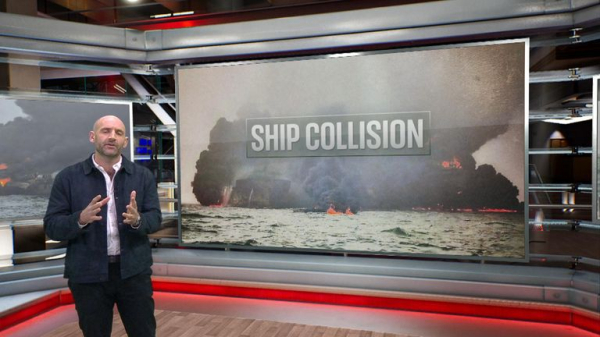
Mr Boyers told Sky News he suspected autopilot may have led to the crash.
After being asked about tracking system showing the Solong heading for the seemingly stationary Stena Immaculate before the collision, he said: “One of them was at anchor and the other would have set a course.
“They have a thing called autopilot, and that’s what I would suspect has been the issue.
“If it’s been put on autopilot and there’s no one on the bridge, which could happen, then it’d just go straight on.
“Autopilot just steers a course, they don’t deviate, there’s no bend in the sea. They just go straight for miles, hundreds of miles, and it would’ve gone in a straight direction.
“It’s difficult to understand what happened, or why it happened.”
He added there would have been alarms on the bridge, which raised even more questions about how the collision unfolded.
Aftermath ’cause for great concern’

Environmental experts have shared their concern over the reported oil spill, with Greenpeace UK releasing a statement saying it was monitoring the situation.
The environmental organisation said: “Both the high speed of the collision and the footage of the aftermath are cause for great concern.
“Right now, our thoughts are with all those affected by the incident and the emergency services responding to the situation.
“At this stage, it’s too early to assess the extent of any environmental damage. But the magnitude of any impact will depend on a number of factors, including the amount and type of oil carried by the tanker, the fuel carried by both ships, and how much of that, if any, has entered the water.
“Sea and weather conditions will also be important in determining how any spill behaves.
“In the case of an oil spill or any loss of hazardous cargo from the container ship involved, the speed of the response will also be crucial in limiting any impact.”